Real-world range vs ARAI: every India EV
Reviewed by the EVz Editorial Team · July 2026 · how we verify
Across the 29 India EVs that have both an ARAI-claimed range and an independently tested real-world figure, real-world range runs an average of 28% below the ARAI claim, as of July 2026. That gap ranges from 12% on the Ather 450X 450X 3.7 kWh to 45% on the Mahindra XUV400 Pro EL Pro (39.4 kWh), and it holds across scooters, motorcycles and cars alike. EVz tracks 304 EV models on sale in India; only these 29 have a published, independently tested real-world range to compare against ARAI, so the other 275 currently carry ARAI figures only. ARAI range is measured in a lab under a fixed test cycle; real-world range reflects how a vehicle performs in actual traffic, weather and rider behaviour, which is why the two numbers almost never match, and why EVz records both, every time, rather than repeating the brochure claim as if it were lived experience.
How we source real-world range. Each figure comes from an independent, published road test for that model (a specialist portal or automotive outlet, not our own lab), cross-checked against the manufacturer's ARAI claim. Each model page shows its verification tier and the date we last checked it. ARAI is a lab figure; real-world is an estimate of typical use, not a guarantee. Coverage today: 29 tested of 304 tracked (10%) - 2 two-wheelers and 27 cars. The median gap is 28%.
See the gap, model by model
Pick any independently tested EV and see its claimed range against what a published road test actually measured. Every share card is free to download and reuse with attribution.
-45% vs the claim - the median gap across all 29 tested models is 28%
Download this model's share card (PNG)Full Mahindra XUV400 Pro EL Pro (39.4 kWh) page
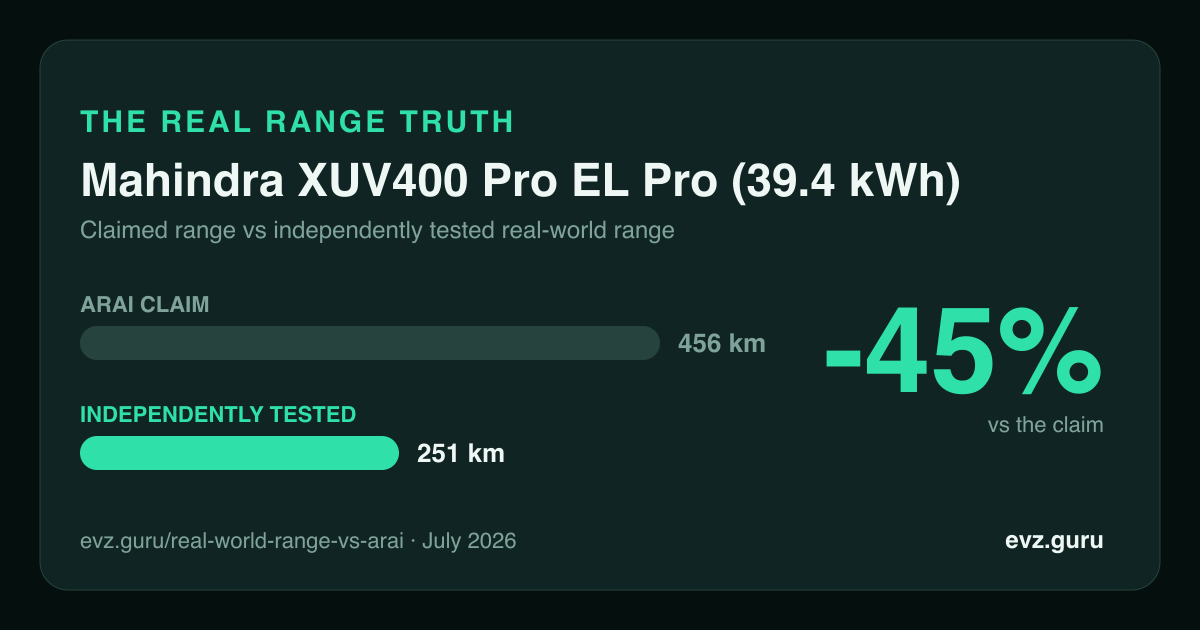
Figures as of July 2026. Free to reuse with attribution (CC BY 4.0): Real-world range vs ARAI, EVz (evz.guru), July 2026, https://evz.guru/real-world-range-vs-arai
Why does real-world range fall short of the ARAI claim?
The ARAI (Automotive Research Association of India) test cycle runs on a fixed protocol (speed profile, load, ambient conditions) that does not reproduce Indian traffic: stop-start city riding, AC or climate-control load, hill terrain, tyre-pressure drift and pillion or cargo weight. Battery packs also lose usable capacity as they age, and very cold or very hot ambient temperatures cut cell efficiency. On two-wheelers, aggressive throttle use in Sport or Hyper modes drains range fastest, which is why some scooters and motorcycles show the widest gaps: the Mahindra XUV400 Pro EL Pro (39.4 kWh) claims 456 km ARAI but tested at 251 km, a 45% shortfall, the largest gap EVz has verified. For the mechanics of how the ARAI cycle works and why it diverges from daily use, see the range vs ARAI handbook entry.
How should I read an EV's claimed range before I buy?
Treat the ARAI figure on a brochure or spec sheet as a ceiling, not an estimate of what you will get day to day. If no independent test exists for that exact model and variant, a rough 28% haircut is a sensible starting assumption, since that is the median gap across the models tested here. Where EVz has an independently tested figure, we show it directly on the model page and in the table above, so you do not have to guess. For a model you are actively comparing, check both figures side by side on a head-to-head comparison , browse the best electric cars above Rs 10 lakh ranked by tested range, or answer a few questions in the Advisor for a shortlist matched to your commute. Then run your own daily distance through the EV savings calculator against the tested range, not the claimed one, before you decide on battery size. You can also see the running-cost impact on running cost per km.
What does EVz do differently on range claims?
EVz never presents an ARAI-claimed figure as if it were real-world range, and we never publish a shortfall percentage for a model unless an independently tested figure exists for it. That is a deliberate honesty rule: 3 of our human-verified models (spec- and price-checked against source) still show no gap percentage here, because no one has independently tested their real-world range yet, and we will not estimate one to fill the gap. Every model here shows its verification tier (sourced or human-verified) and the date we last checked it, per our verification standard.
Use this data
The dataset behind this page is free to reuse under CC BY 4.0: cite EVz and link this page. Download the CSV (29 models: ARAI claim, tested figure, gap, source, date) or grab a ready-made summary share card - every tested model also has its own card via the picker above. Suggested citation:
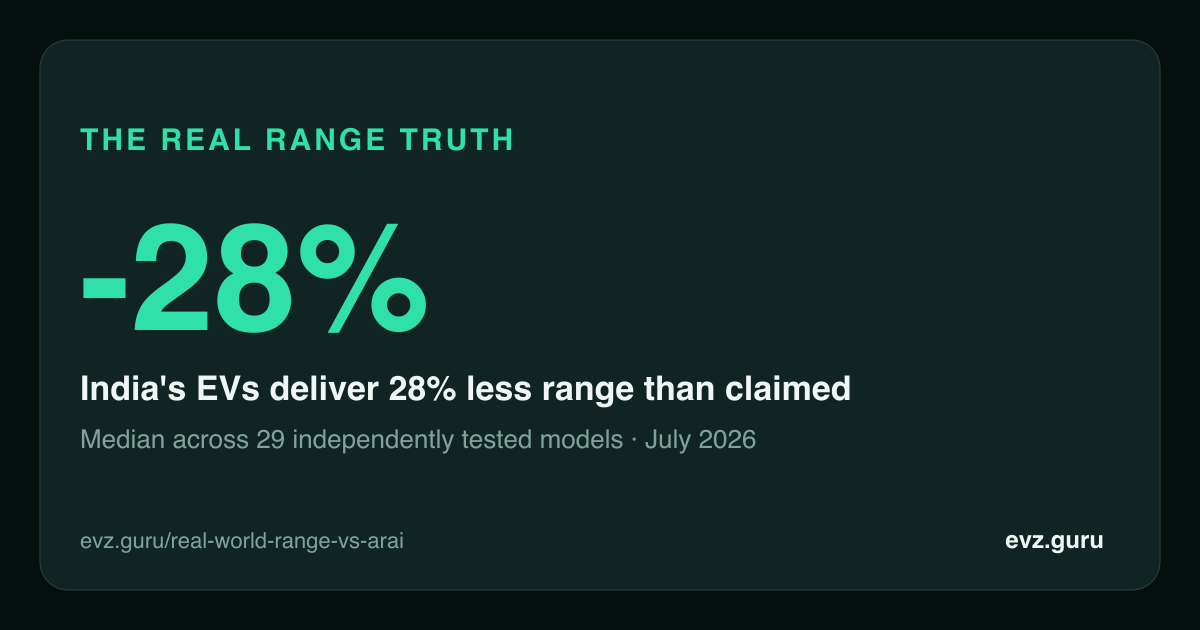
Real-world range vs ARAI, EVz (evz.guru), July 2026, https://evz.guru/real-world-range-vs-arai
The licence covers the data (figures and gaps); EVz's editorial text remains ours. Where a row's independent test source is not yet recorded as a link, the source column is left blank rather than pointed at the brand's own page. Details: data licence & citation.
FAQ
What is the average gap between ARAI-claimed range and real-world range for EVs in India?
Among the 29 EVz-tracked models with an independent test, real-world range averages 28% below the ARAI claim, as of July 2026. The gap runs from 12% (Ather 450X 450X 3.7 kWh) to 45% (Mahindra XUV400 Pro EL Pro (39.4 kWh)).
Which EV in India has the biggest gap between real-world and ARAI range?
Of the models EVz has independently verified, the Mahindra XUV400 Pro EL Pro (39.4 kWh) shows the largest gap: a 456 km ARAI claim against a tested 251 km, a 45% shortfall, at Rs 17,49,000 ex-showroom.
Do all EVs on EVz have a tested real-world range figure?
No. Only 29 of the 304 models EVz tracks have a published independent test as of July 2026. The other 275 show the ARAI-claimed figure only, clearly labelled, with no shortfall percentage attached, so the claim is never mistaken for a tested result.
Is the real-world range gap the same for two-wheelers and cars?
Roughly, yes - both sit in the same broad band. The dataset currently holds 2 tested two-wheelers and 27 tested cars, a small sample, so treat segment-level patterns as directional, not conclusive.
Why do some human-verified EVz models still show no range gap?
Human-verified means a reviewer checked that model's specs and price against its official source, which is separate from whether an independent real-world range test exists for it. 3 human-verified models have no published tested range yet, so EVz shows no shortfall percentage for them rather than estimating one.
How often is this page updated?
Whenever a new independently published road test is added to the EVz catalog for any tracked model. Every figure here is recomputed from the live catalog at build time; the "as of" date reflects the last data pull.